.png?sfvrsn=8865c34e_9)
The CNEL, National Council for Economics and Labour is a constitutional organ provided for by Article 99 of the Constitution of the Italian Republic:
The National Council for Economics and Labour is composed, as set out by law, of experts and representatives of economic categories in such proportions as to take account of their numerical and qualitative importance. It shall serve as an advisory body to the Houses of Parliament and to the Government on such matters and functions as may be vested into it by the law. It may initiate legislation and contribute to drafting economic and social legislation according to the principles and within the limitations set by law.
The National Council for Economics and Labour is composed, as set out by law, of experts and representatives of economic categories in such proportions as to take account of their numerical and qualitative importance. It shall serve as an advisory body to the Houses of Parliament and to the Government on such matters and functions as may be vested into it by the law. It may initiate legislation and contribute to drafting economic and social legislation according to the principles and within the limitations set by law.
Highlights
Powers and responsibilities of CNEL
- Law no. 936 of 30 December 1986
- Law No. 15 of 4 March 2009
- Law no. 234 of 24 December 2012
- Law no. 40, Article 40, of 6 March 1998
- Legislative Decree no. 286 of 25 July 1998
Composition
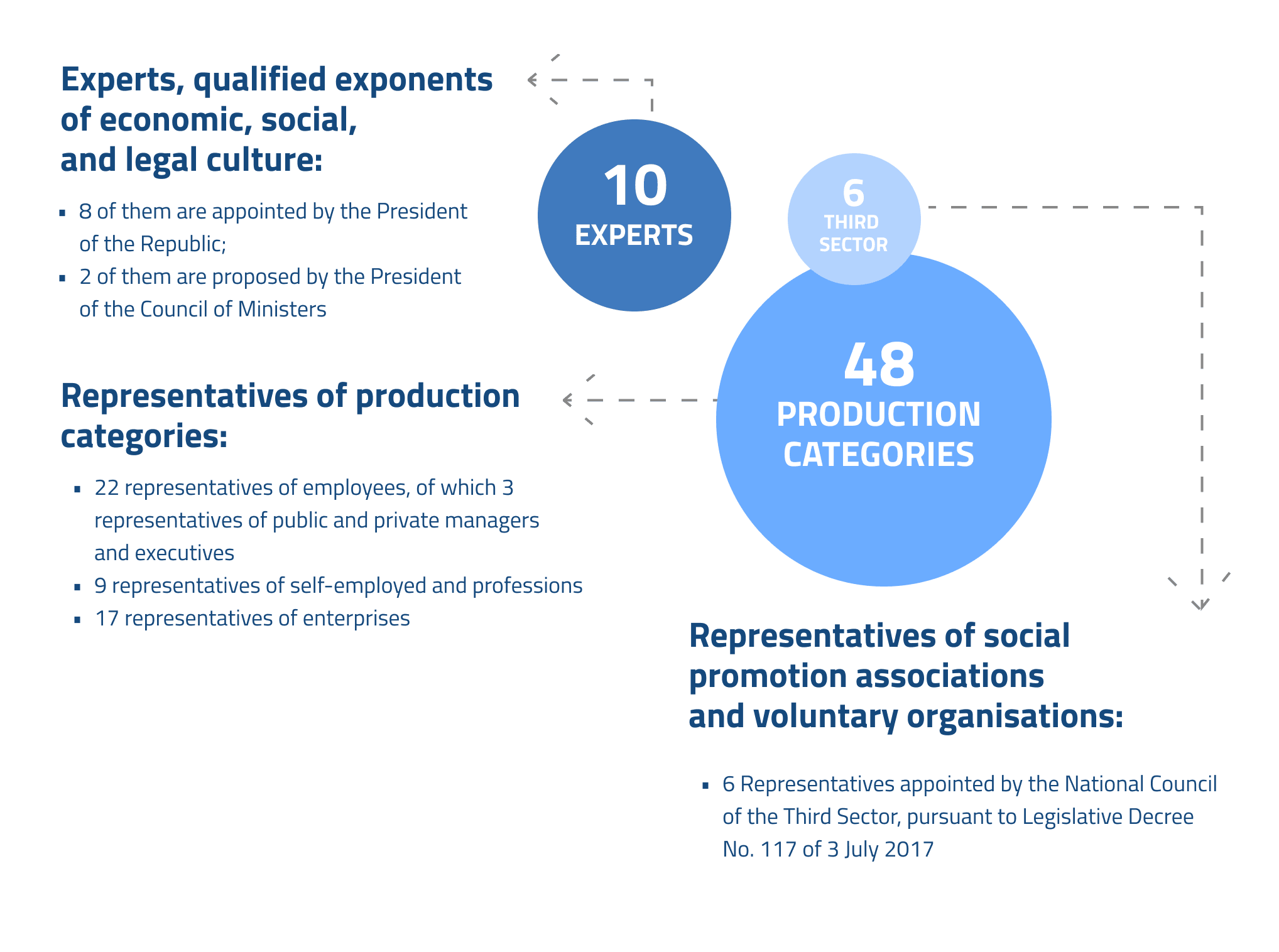
The CNEL is composed of 64 councillors, distributed as follows:
- 10 experts, distinguished representatives of the economic, social, and legal sectors:
- 8 are appointed by the President of the Republic;
- 2 are nominated by the President of the Council of Ministers;
- 48 representatives of the productive sectors:
- 22 representing employees (including 3 delegates for managers and executives in both the public and private sectors);
- 9 representing self-employed workers;
- 17 representing businesses;
- 6 representatives appointed by the National Council of the Third Sector, pursuant to Legislative Decree No. 117 of 3 July 2017.
The position of councillor is incompatible with serving as a Member of Parliament, a member of the Government, or a member of a Regional Council. The term of office is five years. Councillors may be reappointed or removed upon request of the institutions or organizations that designated them.