.png?sfvrsn=8865c34e_9)
The speech of the CNEL President at the presentation of the 2024 Report on Public Services
“A reality of lights and shadows, this is the picture that emerges from the Report on Public Services we present today. More lights than shadows, but we must listen to this complex world, this multifunctional forest, and tell it like it is. This is the ask assigned to CNEL. We need transparency. As Lord Kelvin said, “If you cannot measure it, you cannot improve it”. This is what we are called to do, measure and account for what happens in such an incredibly special sector as public administration services”. Thus stated CNEL President Renato Brunetta during the presentation of the CNEL Report on Public Services.
A NETWORK OF TERRITORIAL PRESENCES IS NEEDED
“The mission assigned to CNEL in terms of analysing and evaluating the quality of national and local public services” highlighted President Brunetta “can and must be integrated, in a virtuous process of complementarity and proximity, by the precious and widespread action of the local autonomy system, as well as that of associations for the protection and representation of citizens and consumers. The goal towards which we want to direct future reports on public services is that of a CNEL increasingly acting as a hub and junction of a territorial network of public presences able to support us in the analysis and evaluation of services, starting with those that significantly impact the quality of life and work-life balance of citizens and families. I am thinking of existing initiative, e such as the Agency for the Control of Quality of Public Services in Rome (ACoS) with which we also intentionally signed an experimental agreement a few months ago. In CNEL's view, similar initiatives should be independently replicated and spread at least in metropolitan cities, by the respective municipalities, further enhancing the crucial role of intermediate bodies and associations representing the widespread interests of users”.
SERVICES PARTICULARLY BENEFICIAL TO THE MOST VULNERABLE
“If we see an emergency room”, Brunetta added, “being overwhelmed or an accident in transport we might think that all services do not work, but that’s not the case. The public administration is made up of many networks that respond and are there. The public administration exists, safety is there, schools are there. Not always as we would like, not always as needs would require, but what emerges is an extraordinary offer. An offer of products and services that serve ordinary people, the vast majority of Italians, and particularly the most vulnerable who cannot afford to buy those products and services in a parallel market”.
CNEL WANTS TO GIVE VOICE TO CITIZENS
“This year, despite maintaining continuity with the past”, Brunetta added, “we have introduced many novelties into the Report on Public Services, primarily with an approach more oriented towards evaluating the impact on services users. We want to give voice to the users first. We want to make CNEL the meeting point where we can gather the many voices from citizens, the meeting point for all citizens organisations trying to improve public services offerings, also in a synergy perspective between public and private”.
ZANGRILLO: WE MUST LISTEN TO OUR CLIENTS
“The CNEL Report on Public Services”, said the Minister for Public Administration, Paolo Zangrillo “is a highly significant and valuable tool for understanding which direction to take. An essential point in the ability of the public administration to respond to users’ needs and put the person at the centre. We do this by dialoguing with citizens and businesses, i.e. our clients. We must listen to our clients. Updating regulations is necessary but not sufficient. To make regulations effective, it is essential to drive changes through our personnel, the public administration workers”.
SEVERINO: WE MUST SELECT THE BEST MANAGERS AND THEN TRAIN THEM
“We need something to tell us if the efforts to improve the public administration have been successful”, stressed Paola Severino, president of the SNA, “and for this reason the work done by CNEL in preparing the Public Service Report is crucial. What I want to emphasise is the importance of selecting public managers. We must choose the best. Today, we can say that our public administration is much better than many others because of its ability to select. We must choose the best and then continue to train them, so that their competence is always guaranteed”.
FEDRIGA: UNDERSTANDING USERS NEEDS
“The presentation of the Report on Public Services”, said Massimiliano Fedriga, president of the Conference of Regions and Autonomous Provinces, “fully falls within the scope of the agreement we signed with CNEL in recent months, because it helps us strengthen the services provided. I think that starting from the ground up is fundamental. We must understand users’ needs and define procedures based on those needs and not the other way around. Otherwise, we penalise the public administration. The public administration is often in trouble due to lack of transparency and simplification”.
PELLA: ESSENTIAL ROLE OF LOCAL AUTHORITIES
“Local authorities play an essential role”, said Roberto Pella, Acting President of ANCI, “in the provision of services in the territory and in the relationship that the public administration has with citizens and companies. The public services sector has undergone significant innovations in recent years, both at the local level, both in terms of trust and regulation. The CNEL Report is important not only because it gives us a snapshot but also because it stimulates us to improve the performance of our services”.
ROMOLI: PRODUCTIVE COLLABORATION WITH CNEL
“We have welcomed with great interest the invitation of CNEL”, highlighted Alessandro Romoli, President of UPI Lazio, “to start a productive collaboration, also with a view to realising the Report on Public Services, in order to collect data and ensure an even more widespread approach. Provinces can grasp and understand the trends and needs of territories. But we need a reform that provides for a reorganisation of functions. We need to restore coordination that can be attentive to local needs”.
NADDEO: CONTRACTS ARE NOT JUST ECONOMIC TREATMENT
“The problem with public contracts is the conception that administrations have of them. The contract goes beyond economic treatment and includes many other factors”, stressed Antonio Naddeo, President of ARAN. “In particular, the contract in public employment is not only an economic part, but also includes agile work, merit, performance, training. If the contract is seen by administrations as mere fulfilment, then it will certainly be applied precisely, but the true sense that this instrument can have will be lost”.
ANASTASI: MERIT EVALUATION SHOULD NOT BE AN END IN ITSELF
“Merit is a process”, said Giovanni Anastasi, president of Formez, “which must be subjected to criteria of objectivity and transparency, but above all, it must produce consequences; otherwise, it is an end in itself. This means that when a person is evaluated, then training must be calibrated and targeted on what emerges from the evaluation. Our main mission, as Formez, is to support and assist public administrations, to help them provide more efficient services to citizens. To do this, as a public administration laboratory, we have assigned easily monitorable indicators, closely related to the concept of public value”.
MALLEN: PUBLIC ADMINISTRATION INCREASINGLY ORIENTED TO EVALUATING SERVICE IMPACT
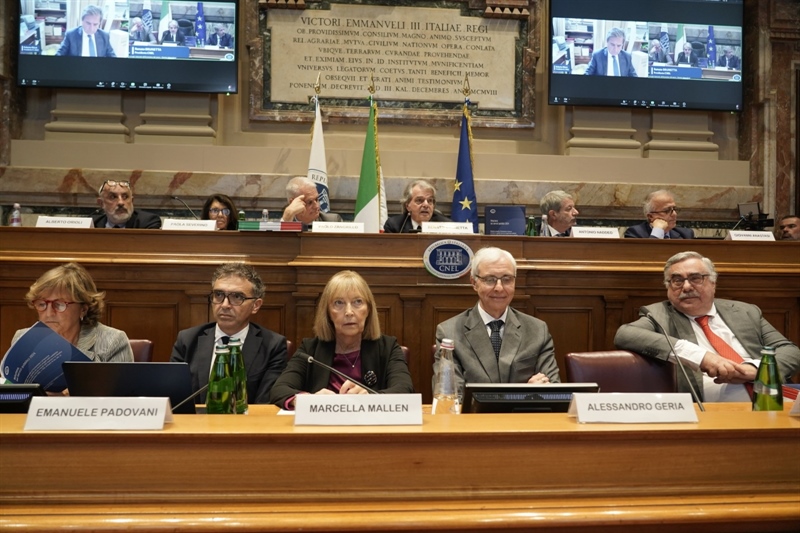
“This year's CNEL Report on Public Services - said Marcella Mallen, CNEL councillor and coordinator of the Report itself - has been set with an innovative methodology and approach, especially from the point of view of measuring the performance of the public administration, which today is increasingly oriented towards evaluating the impact generated on public services users and on sustainability, promoting lasting and inclusive well-being”.
GERIA: MORE INVESTMENT AND IMPROVING MULTILEVEL GOVERNANCE
“Measuring the impact of the quality of public services - stated Alessandro Geria, CNEL adviser and coordinator of the National Observatory on Territorial Social Services – is not an easy task, because territorial differences play a very relevant role. The analysis work underlying the Report highlights an increase in public spending on social protection, but despite this, we must work on the investment front, which in some cases is still too low. We also need to solve the problems related to multilevel governance, which does not always allow small municipalities to address social inequalities”.
PIRANI: IDENTIFYING BEST PRACTICES AS AN OPPORTUNITY FOR PUBLIC ADMINISTRATION GROWTH
“The identification of best practices represents a novelty of the 2024 Report and is an important growth opportunity for the public administration. This year we extended the evaluation field not only to central and local public administrations, but also to public service companies. The evaluation started from the bottom, thanks to the involvement of consumer representatives. It is a new approach, that increases the ability to provide tools aimed at improving the performance of the public administration, enhancing the perspective of the end-user”. This was stated by Paolo Pirani, CNEL adviser and coordinator of the Permanent Forum for the Culture of Responsible and Sustainable Consumption.
Other speakers included Efisio Gonario Espa, professor at the Luiss Guido Carli University; Emanuele Padovani, professor at the University of Bologna; Carla Collicelli, CNR researcher and member of the ASviS (Italian Alliance for Sustainable Development) team.