.png?sfvrsn=8865c34e_9)
Significant improvements but also territorial and social gaps
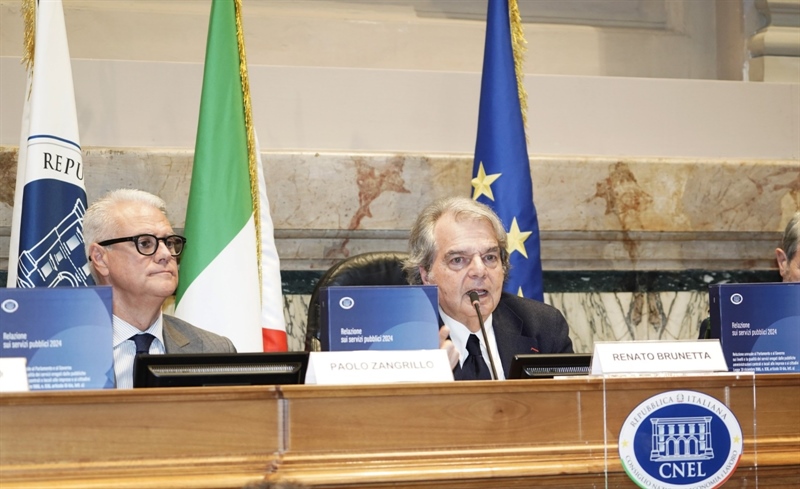
A picture of lights and shadows emerges from the CNEL annual report on public services, presented today at Villa Lubin. The report reveals many good practices and significant improvements, but also numerous facets reflecting ancient fragilities and considerable territorial and social disparities. Positive indicators related to life expectancy (83.1 years) and elderly health (37.8% in good health).. The level of financial resources for social protection, health prevention and childcare services is increasing. The educational level of the population improves. The percentage of separate waste collection and recycling rises. But there are still shortcomings. The level of economic commitment is often below the European average. There are critical issues in public transport. Early childhood services are inferior to major EU countries. The phenomenon of water loss for domestic use persists. There are significant regional disparities in services performance and inequalities penalising economically and socially disadvantaged groups.
Before the works began, a minute of silence was observed for the National Day for Victims of Work Accidents, celebrated yesterday, 13 October 2024.
Click here to read the speakers’ speeches.
Moving to an ex-ante logic
The Report, which CNEL pursuant to Italian Law 936/1986 is required to send annually to Parliament and the Government, this year focused on the real impact of public services, examining how they contribute to improving quality of life and supporting the country's economic growth. With this in mind, the focus was on the UN 2030 Agenda and its 17 Sustainable Development Goals (SDG's). The Report is thus enriched with new criteria, aimed at shifting the monitoring system from an ex-post accountability approach to an ex-ante logic, not just in terms of results produced but also their impact on the reference targets, with continuous involvement of beneficiaries, communities and territories.
The Report is the result of the collective work of CNEL councillors, bodies and offices, along with external experts and collaborators. An extensive process of listening and confrontation was also carried out, involving a wide range of subjects both on the service supply and demand sides.
The “Southern Factor” remains significant
The “Southern factor” manifests in two distinct ways. The first, relates to situations where higher costs correspond to lower level of services. This scenario is particularly evident in land management and road services, waste management and nursery services. This is what emerges from the CNEL Report on public services, presented today at Villa Lubin. The second aspect concerns a reduced resources allocation, leading to a lower provision of services. This phenomenon is evident in local police services, educational support and social services, where the limited availability of resources is directly correlate with lower quantity and quality of services provided. For instance, the coverage of potential demand for school meals in municipalities is 33.3% in Tuscany and only 9.6% in Campania. The South spends about 37% more than the North-West and 50% more than the North-East, but has a recycling rate that is 11.9 points lower than the North-West and 17.4 points lower than the North-East. In terms of social services, the financial commitment in the South (EUR 95 per capita) is always lower than any other region (EUR 124 in the North-East, EUR 129 in the Centre, and EUR 134 in the North-West), despite a context in which socio-economic deprivation rates are much higher. Nursery services are also particularly lacking in the South, with coverage rates well below the average (7%, compared to 18.5% in the North-West, 21% in the North-East and 22% in the Centre).
Public administration between criticalities and innovation capacity
Throughout 2023, the process of strengthening public administrations has further solidified, as noted in the CNEL Report on public services, presented today at Villa Lubin., This process, which started intensively in 2022, has been significantly supported by resources from the National Recovery and Resilience Plan (PNRR). Positive aspects highlighted in the report include: the consolidation of new recruitment flows; an intense resumption of training activities; a gradual return to normal contract negotiations; the introduction of new simplification tools; and widespread support for digitalisation. On the critical side, there are challenges such as keeping pace with the significant staff turnover in PA over the years, as well as the need to “reconvert” a high number of professionals, especially in relation to digitalisation processes. Public administrations show some weaknesses consolidated over the years (particularly during the period of turnover freeze, training budgets cut, and contract negotiations freeze), but also a significant capacity for reaction and innovation.
Staff shortages in healthcare
Public healthcare spending has been raising since 2020, but it remains among the lowest in Europe (75.6% of the total), while private healthcare spending by citizens continues to grow (+5% in the last year alone). This is highlighted in the CNEL Report on public services, presented today at Villa Lubin. The phenomenon of giving up necessary healthcare due to economic and organisational problems (which reached 7.6% of the population in 2023) is spreading, and the reality of impoverishment caused by health-related issues (affecting 1.6% of households) is growing. In healthcare, there is also a real age crisis, alongside the issue of staff shortages in many areas of this sector, particularly in emergency medicine, family medicine, and nursing. Furthermore, there is an increasing trend of healthcare workers leaving both the public sector and, in many cases, the country.
More school leavers but education spending below the EU average
In the education field, the level of schooling among the population is increasing. The percentage of people aged 25 to 64 with at least a secondary school diploma has reached 65.5 % of the total in that age group (up from 63% in 2022 and 62% in 2019). This is highlighted in the 2024 CNEL Report on Public Services. The proportion of university graduates is also rising, especially among those aged 25-34. School drop-out rates have decreased (by 6 percentage points between 2011 and 2021) and the NEET rate has also dropped from 19% to 16.1% in 2023. An increasing number of students are completing university studies (rising from 54.5% to 65%). In a European comparison, the percentage of women enrolled at universities in Italy is higher than the European average (55.9% in Italy compared to 54.2% in Europe in 2021).
According to the report, however, school spending as a percentage of GDP is still lower than that of major advanced countries, standing at 3.2 % (2020) compared to an average of 3.6%. Even at the university level, Italy invests less in tertiary education, relative to the population with completed tertiary education, compared to the OECD average (1% vs. 1.5%) and the EU25 average (1.3%). The attendance rate of early childhood education services is also below the European average: in 2021, 33.4% of children aged 0-2 years compared to the EU average of 37.9%, 74.2% in the Netherlands, and 50% in France.
In Italy 40% of metro networks compared to the average of the main European countries
Regarding transportation, the CNEL report on public services highlights the excessive use of private cars (40 million in 2023) for urban and suburban transport and its substantial continuity over the years (66.3% of trips). Italy has just over 40% of the metro network compared to the average of the main European countries, 53.7% of tram networks and 56% of suburban railway networks. A large portion of car users, almost 50% of the total, does not even consider using public transport for commuting. Moreover, in terms of public transport, the differences between small towns and cities are striking with respect to the weight of public transport: 4-5% vs. 14.7%.
“Impatto PA” Award Winners
During the presentation of the CNEL Report on Public Services, the “Impatto PA” award, established for the first time this year, was handed out. The award gave voice to consumers in selecting good practices in public administration, favouring “bottom-up” reports. Here are the three winners:
-
Acquedotto Pugliese, for water service provision
For its commitment to sustainability, strategically integrated into water service management. A public company owned by the Apulia Region, since 2014 it has developed a path aimed at adopting a Sustainability Plan, aligned with the Sustainable Development Goals and the Regional Strategy for Sustainable Development.
-
ATERSIR, for water and waste services monitoring
The monitoring system designed and implemented by ATERSIR with the contribution of civil society, stands out for its commitment to promoting the spread of participatory approaches and models in the processes of collecting, processing and interpreting significant data concerning the quality policies of public action. The initiative involves the collaboration of the most representative consumer associations in the area.
-
RAI for “M'illumino di Meno”
The initiative “M'illumino di Meno”, aligned with the Sustainable Development Goals of the Agenda 2030, stands out for its commitment to raising awareness and promoting a conscious environmental culture and sustainable lifestyles, extending its influence throughout the country. The initiative not only informs and educates, but also transforms “beneficiaries” into real “protagonists”, by adopting a participatory activism model that directly involves the recipients, making them active participants in the change.
Read the editorial of the CNEL President in Il Sole 24 Ore in English
Download here the summary of the REPORT in Italian
Download here the full Report in ITALIAN