.png?sfvrsn=8865c34e_9)
by Renato Brunetta
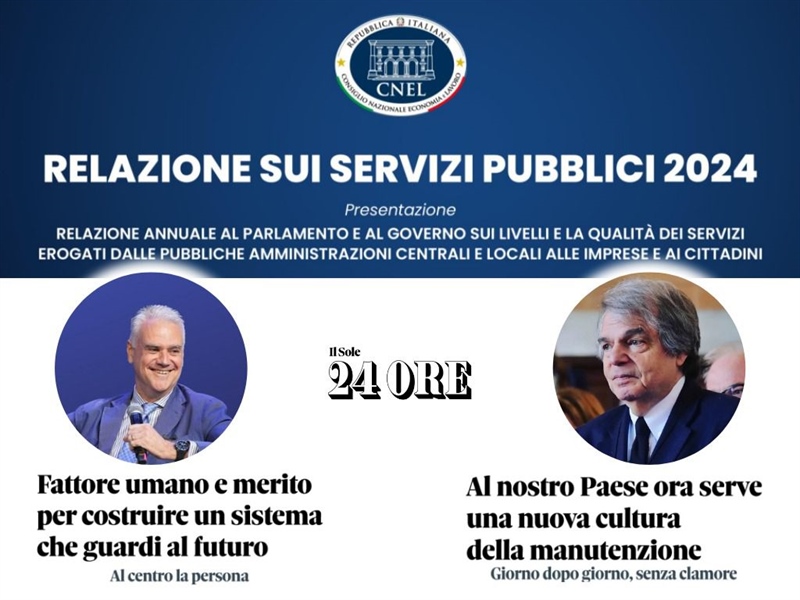
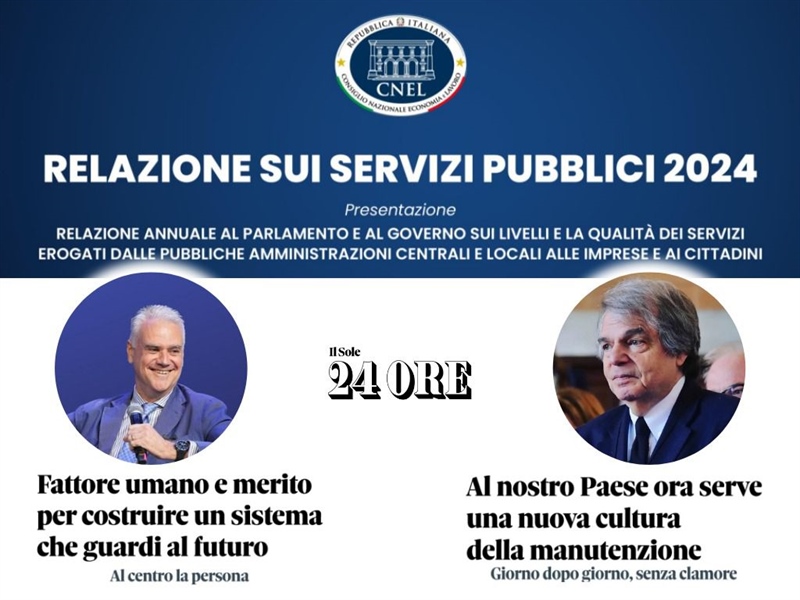
“Education improves, female emancipation and environmental sustainability grow, healthcare suffers, public offices strengthen, but the culture of maintenance remains lacking: this is the picture of lights and shadows offered by the Annual Report on the Quality of Services Provided by Central and Local Public Administrations to Businesses and Citizens, which is presented this morning at the CNEL. This appointment of transparency and evaluation is another step in the path started with Italian Law 15/2009, during my first mandate as Minister for Public Administration and Innovation, which assigned CNEL the task of drafting this Report.
This year's edition, while maintaining continuity, highlights several innovations: firstly, a more user impact-oriented approach, within the framework of the sustainable development goals (SDGs) of the UN 2030 Agenda. Another innovation is the emphasis on good practices, with the CNEL “Impatto PA” award, based on “bottom-up” reports, favouring the perspective of citizens, businesses and communities interacting daily with the public administration. This is the result of a vision promoting constructive and collaborative dialogue between citizens/businesses and public administration.
But let’s get to the point: the state of public services in Italy today is dual and jagged. Some well-being indicators reflect improvements, such as an increased life expectancy (83.1 years), a higher number of graduates (65.5% in 2023 compared to 63% in 2022) and a growing share of university graduates among young people (25-34 years). The school drop-out rate has also declined (-6 percentage points from 2011 to 2021) and the number of NEETs decreased (from 19% in 2022 to 16.1% in 2023). The number of women enrolled in universities exceeds the European average (55.9% compared to 54.2%) and the number of female teachers and rectors is increasing, although significant gender disparities persist.
From an environmental perspective, the average waste separation rate has reached 65% nationwide, with peaks of excellence in many municipalities, and recycling has risen to 49.2%.
Water resources management shows positive signs, with increased investments in water supply and good quality bathing water (89% classified as “excellent”). Sustainable mobility is also growing, with the expansion of cycling lanes and an increase in the conversion of private mobility to electric.
Nevertheless, shortcomings are still present. Financial resources dedicated to the UN Agenda 2030 sustainability goals are often below the European average, especially in healthcare, where, despite an increase in public spending since 2020, it remains among the lowest in Europe. As a result, private citizens spending has grown by 5% in the past year, with public services waiting lists often unsustainable. Education spending also remains lower than that of the main advanced countries.
It must be said, and the Report makes this clear, that the process of strengthening public administrations, which had already started with intensity in 2022 thanks to the NPRR resources, was further consolidated in 2023.
But more than ever, a paradigm shift towards a renewed culture of maintenance is essential. A culture removed or marginalised because it is not seen, not announced, and does not generate immediate consensus. A culture that, on the contrary, should gain centrality in public policies design for its social value. I am referring to infrastructure services: schools, roads, hospitals and even railways, about which have been much discussed lately. Six years ago, the Morandi Bridge disaster reminded us, once again, how Italy has a very noble history in terms of project planning, but not equally in maintenance.
But there is more. Speaking of a culture of maintenance means investing in urban regeneration and recovering peripheral areas. To do this, it is necessary to overcome short-term logic and easy consensus. It also requires avoiding the polarising opposition between public and private and instead thinking in terms of Public Private Partnership (PPP). Collaboration, synchrony, proper roles distribution are needed. It is necessary to value the many “maintenance agents”, who operate quietly, day after day, and to whom we owe much for collective well-being. I’m thinking about the many networks present in the territory, both known and less known, such as the often misunderstood and abandoned network of reclamation consortia, which have contributed not only to changing the economic history, but also the territorial shape of our country. I am still thinking of the potential maintenance care of the productive sectors, which could be carried out extensively by the Chambers of Commerce. I am thinking about the role that digital platforms and AI could have, if their firepower is directed to favouring a proximity strategy and well-being for people and territories.
It is essential to work together, with a broad involvement of civil society, engaged in discussions on issues of common interest. And CNEL, the house of intermediate bodies, is an open house. Especially for the future”.
Gallery